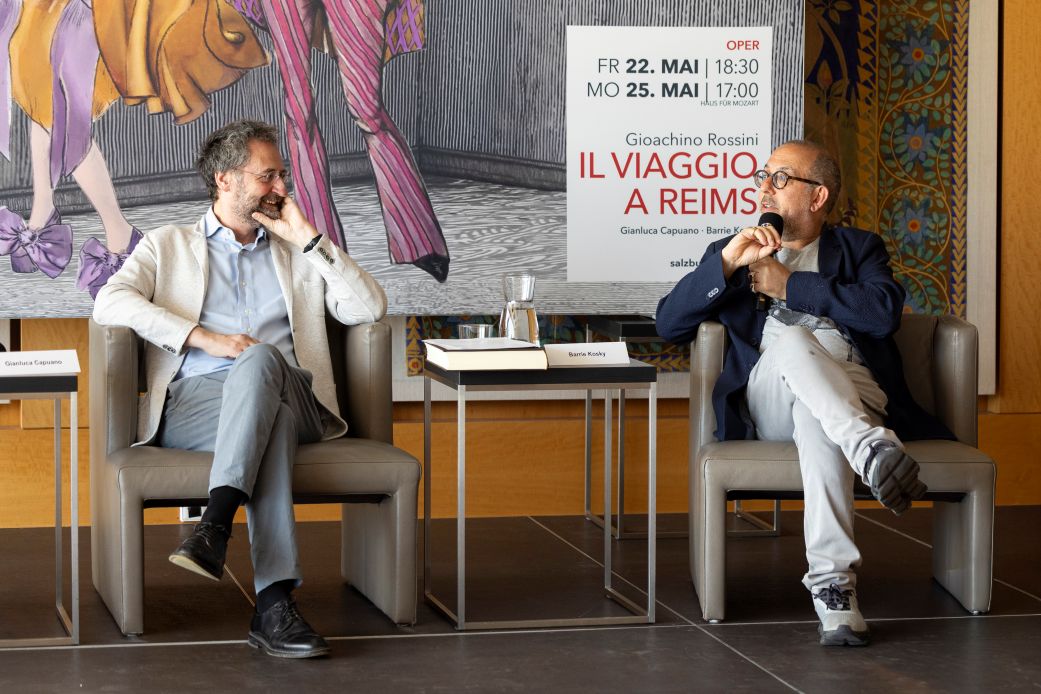
“I am very grateful to be doing this wonderful ‘nonsense’ Rossini piece here in Salzburg,” director Barrie Kosky confesses during a press conversation on the new production of Gioachino Rossini’s Il viaggio a Reims. Gianluca Capuano, the production’s conductor, adds: “It was like a miracle when the Rossini researcher Philip Gossett found a fragment of the manuscript at the Santa Cecilia Library in Rome in 1977. What we know today as Il viaggio a Reims is a reconstruction, fleshed out with material from Le Comte Ory and other sources. We can truly rejoice in this rediscovery!”

So far, Rossini’s first opera for Paris, which was also his last in the Italian language, has not been performed too often. Combined with the situational plot, this means Barrie Kosky is faced with a special constellation: “This is some of the best music Rossini ever wrote. For a director, it’s a gift, because you can build a brand-new story. It doesn’t have a long history of audience reception, so the viewers have no preconceived notions, and at the same time, the plot is easily understood. There isn’t one moment of boredom in the music or the piece – but you do have to make something out of it.” What’s the story? An illustrious traveling party is on its way to attend a coronation; on the road, they get stranded at a hotel because, absurdly, all the town’s horses have disappeared. Barrie Kosky: “During the first 30 minutes, the only dramatic thing that happens in the libretto is that a French Contessa believes she has lost her hat. This causes her to sing a ‘mad scene’ aria as if she were Lucia di Lammermoor. She gets her hat back and sings an aria that sounds as if the hat were the love of her life. Around this smidgeon of a story, this skeleton, Rossini constructs sensational music.”

Gianluca Capuano, Chief Conductor of Les Musiciens du Prince – Monaco, photo SF/Erika Mayer
For Gianluca Capuano, chief conductor of the orchestra Les Musiciens du Prince – Monaco, with which he will perform the opera in Salzburg on historical instruments, the work contains two outstanding musical moments: “The Sextet No. 3 and the Gran Pezzo Concertato: a piece for 14 singers performing a cappella. They begin singing this beautiful song, and the orchestra only joins in later. That’s a moment when we can hear the mature Rossini, at the height of his creativity.” Barrie Kosky agrees: “We are doing this opera because the music is breathtaking. It has incredible brilliance: in the construction of its ensembles, in its melodies, in its form and grandiose wit. It’s incredible how he manages to pour this basic feeling into music. To me, there are only three composers whose music one hears and immediately has to smile: Mozart, Offenbach and Rossini.” Gianluca Capuano mentions another of Rossini’s innovations, which he implemented in his portrayal of the various nationalities of the traveling party: “It’s a parade of national anthems, real or imagined. This, however, was also a delicate issue, for example when it came to the French anthem: of course he didn’t use the Marseillaise. One couldn’t be caught quoting the Revolution. Then there’s a Tyrolean anthem that I didn’t even know myself. We do a bit of yodelling, adding local colour, but always with respect for all countries and nations.”

Gianluca Capuano and Barrie Kosky have returned to Salzburg for another collaboration, following last year’s hit, the Vivaldi pasticcio Hotel Metamorphosis, which won multiple awards. This year’s Whitsun Festival has the motto “Bon Voyage”, photo SF/Erika Mayer
Rossini composed Il viaggio a Reims for the best vocalists of his time. In Barrie Kosky’s production, there are other challenges as well: “We have an ensemble that moves a lot and sings simultaneously. The music is very hard to sing, there’s lots of coloratura and many long bel canto melodies. That means you need singers who are physically very well trained and fit. Some of them had never worked with me before this production, so the first week was a bit of a shock for them.” Once again, the Festival’s artistic director, the mezzo-soprano Cecilia Bartoli, will take on a role herself this year, that of Corinna, a Roman poetess. Gianluca Capuano: “This character, Corinna, is taken from a very famous book by Madame de Staël that might be called the first truly feminist novel, which was the model for the libretto. Corinna is a singer who improvises. That used to be the Italian tradition. When such a singer-poetess came to town, that was a real event, and thousands of people came to hear her.” Barrie Kosky has the final word: “Speaking of lightness, I like to compare the piece to a soufflé, or a fizzy, fragile, wonderfully sweet confectionary. I’d like to emphasize that to me, a comedy is ten times harder to direct than a big Wagner opera, for example. It looks easy, but it requires weeks of rehearsals, hard work and concentration. It means timing, timing, timing, because after all, comedy is rhythm!”

Director Barrie Kosky is staging his second opera at the Whitsun Festival; it is his fourth work in Salzburg, photo SF/Erika Mayer
Sidebar: Cecilia Bartoli on the role of Corinna, her role debut in Salzburg
I have long been interested in the role of Corinna and the opera Il viaggio a Reims, both in musical and formal terms. This piece is truly a curiosity within operatic literature, and it also occupies a special position within Rossini’s oeuvre. He went on to reuse five large sections of the music, including the famous concertato, in Le Comte Ory. That’s an opera in which I sang the page Isolier when I was very young at La Scala in Milan, and later the Contessa several times at other opera houses. Therefore, I had always wanted to explore Ory’s prequel, Il viaggio a Reims. Furthermore, at the world premiere of Il viaggio, the legendary Giuditta Pasta sang the role of Corinna. Her roles generally suit me very well, in terms of vocal character and tessitura. The two arias are extremely beautiful, but also demanding – they might seem simple in musical terms, since they don’t contain any of the coloratura garlands so beloved by Rossini. Yet Corinna is a famous poetess, so text and nuances need to be especially meaningful and delicate. (After Press Materials).

Marijan Zlobec