Ivo van Hove makes his directing debut at the Salzburg Festival with the new production of Ingolstadt, a combination of Marieluise Fleißer’s seminal plays Fegefeuer in Ingolstadt and Pioniere in Ingolstadt presented as a co-production with the Burgtheater in Vienna. Opening the event, Bettina Hering quoted Elfriede Jelinek, describing the suggestive power of Fleißer’s texts: “Poets can bring anything to life, and this poet in particular.”

Bettina Hering, Director of Drama, Ivo van Hove, Director, photo SF/Birgit Probst
She asked Ivo van Hove how he had discovered Marieluise Fleißer and what interested him about her. He recalled how he first encountered her texts while studying directing in Belgium in the early 1980s and was so intrigued that he immediately bought one of her books. Her stories, many of them strongly influenced by Catholicism, are not universally comprehensible and relatable, but his personal background gave him immediate access to her work. At the Münchner Kammerspiele, he encountered passages from Fegefeuer in Ingolstadt as directed by Susanne Kennedy – he recalled that he had not seen other productions of her work before now. As a film fan and admirer of Rainer Werner Fassbinder, he was surprised that the latter had made a film version of Pioniere in Ingolstadt. Asked by the Salzburg Festival and Vienna’s Burgtheater whether he was interested in directing this co-production, he quickly realized that this was an ideal opportunity, and that he wanted to create a new play from two separate ones, Fegefeuer and Pioniere in Ingolstadt, simply entitling it Ingolstadt.

Bettina Hering inquired how he conceived this version: whether, for example, there were doublings of figures. “No,” said Ivo van Hove, “if you don’t know the two plays, this appears as one single piece. There is one stage set, a large landscape made up of people.”

Bettina Hering, Director of Drama, Ivo van Hove, Director, photo SF/Birgit Probst
Bettina Hering also asked about the pivotal idea regarding the amalgamation, and whether anything – as is often assumed, with some prejudice – is lost in this process. “You lose something, you win something,” Ivo van Hove answered, adding that he preferred to talk about the elements gained. The young adults in Ingolstadt live in a dark world full of inhibitions, rules and prohibitions, from which they are trying to escape. However, none of them succeed. “In a way, it is a simple story, which must be told simply,” Ivo van Hove declared. The most important subject in the play, to him, are the Catholic power structures. This is most clearly recognizable in the case of Olga, who becomes pregnant by a man from the village. He demands an abortion, she wishes to keep the child – an abortion would be a mortal sin, from a Catholic point of view. The play is about forbidden things which must never be discussed or shown to the world. The hierarchical power structure is represented mainly in the universally hated figure of the Feldwebel or Sergeant. It is a world of frustration and violence which van Hove sees portrayed here, and its law is: anyone who refuses to conform and run with the group is an outsider, becoming a scapegoat with whom one can do as one pleases.

Since it is a story about youth, it also provides an ideal platform for the Burgtheater’s young ensemble, said Bettina Hering, asking Ivo van Hove about the timeframe in which he is setting the story. “Not in the 1920s,” he declares, “nor from any kind of updated perspective. It’s a mystical piece, like Shakespeare, and requires no updating. It is very clear in each and every sentence.”

SF/Matthias Horn
Bettina Hering asked whether to his mind, other subjects – such as the criminalization of abortions, in light of current events such as the reversal of “Roe v. Wade” in the USA – also seem to be repeating themselves one hundred years later, or whether the distance in time was palpable. Ivo van Hove responded that he is always telling contemporary stories, never tales of “way back when”, even when directing operas. To him, staging is always for today’s audience. Fleißer’s writing is characterized by the manner in which she unfolds landscapes of the soul, emanating from the inside, from darkness. Fleißer herself stated that she did not have a premeditated plan when writing, and this was a way of creating theatre.

Maximilian Pulst (Korl), Ivo van Hove (Director), Lilith Häßle (Berta)
Asked about Fleißer’s specific linguistic style, Ivo van Hove confirmed that the language in this case is difficult, leading him to study it in great detail. This is another reason that Fleißer’s plays are rarely performed abroad, as her work is difficult to translate. Even though her language is not a dialect, it is developed from a dialect. He described this as a challenge which the young actors were facing with an open mind.

Ivo van Hove
How does he find the timeless plays he directs, Bettina Hering asked. “I only accept plays which are compelling to me – life is too short for anything else,” Ivo van Hove emphasized. He described himself as someone who loves preparation, needing two to three years of advance notice in order to consider the constellation of the figures and the dramaturgy of content. He reads a lot, yet often subjects are suggested to him by others. Sometimes films inspire him, for example Italian, German and American cinema of the 1970s and 1980s. In principle, he said, he is on the lookout every day, carrying a small notebook to jot down spontaneous ideas. Sometimes this leads to productions, sometimes not.

Ingolstadt 2022: Marie-Luise Stockinger (Olga), Jan Bülow (Roelle)
Regarding his working method and team, he revealed: “When you have known each other for a long time, working becomes more difficult – but in a positive way. You no longer need to prove anything, but you are always pursuing an ambitious goal. I only work with people who want to reach that same goal.” When directing international texts adapted to a certain country, he also takes into account the theatre he is working in, talking extensively to those responsible there. Indeed, for him there are pieces that only work in certain places – and that applies to Ingolstadt as well. At the same time, however, he emphasized that the piece follows his own vision of theatre: when confronting people with the unexpected, conceiving figures differently than for the theatre, sometimes the resulting production is particularly felicitous.

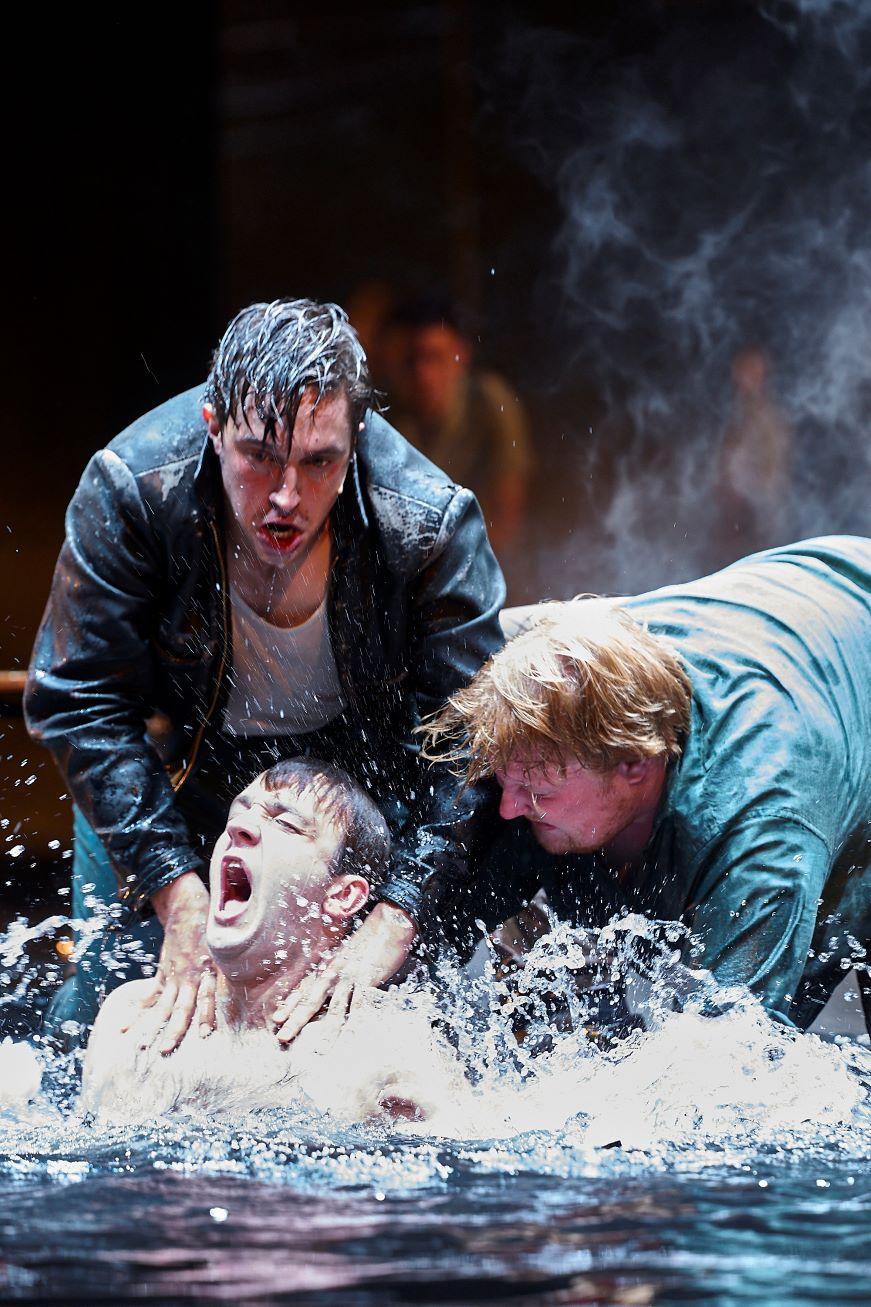
Ingolstadt 2022: Jan Bülow (Roelle), Tilman Tuppy (Peps), Lukas Vogelsang (Christian), SF / Matthias Horn
As a director, he said he locates himself between different stylistic movements, while keeping an open mind towards them – as someone once said, he is simultaneously a maximalist and a minimalist. He feels a connection with the Salzburg Festival during Gerard Mortier’s era as artistic director, both in drama and opera. Therefore, he is delighted to work here as a director now. (After press materials)
Marijan Zlobec